













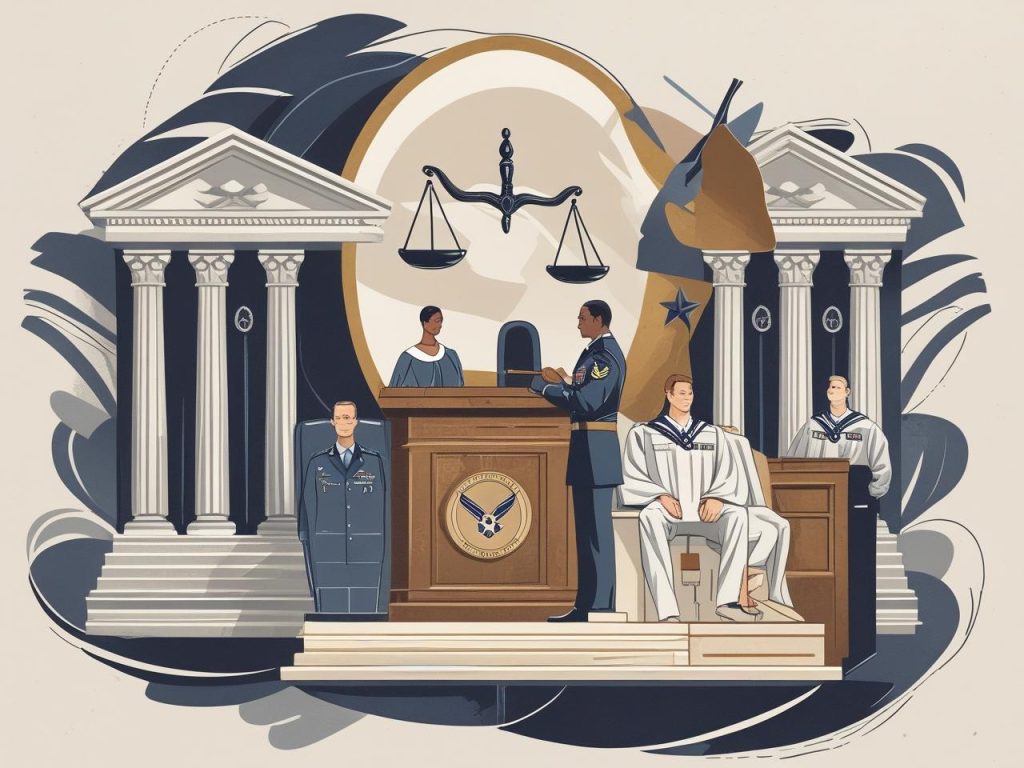
Air Force court martials serve a critical function within the military justice system, designed to maintain discipline and uphold the rule of law among service members. Governed primarily by the Uniform Code of Military Justice (UCMJ), codified in 10 U.S.C. §§ 801–946, court martials provide a statutory mechanism for adjudicating military offenses. These proceedings reflect the distinct legal needs of a military environment and are constitutionally supported under Article I, Section 8 of the U.S. Constitution, which grants Congress the authority to regulate the armed forces.
The existence of court martials reflects the military’s commitment to maintaining order, discipline, and accountability, which are essential for operational effectiveness and unit cohesion. Moreover, court martials address offenses that can range from insubordination and dereliction of duty (Article 92, UCMJ) to more severe crimes such as sexual assault (Article 120, UCMJ) or drug distribution (Article 112a, UCMJ).
By adjudicating these matters through a structured legal process, the Air Force aims to deter misconduct, protect the rights of service members, and ensure that justice is served. The court martial system has been upheld repeatedly by courts as a constitutionally sound alternative to civilian courts, most notably in Parker v. Levy, 417 U.S. 733 (1974), where the Supreme Court acknowledged the unique demands of military discipline.
Key Takeaways
- Air Force court martials operate under the UCMJ and address offenses from minor infractions to capital crimes.
- The process includes investigation, charging, trial, and potential appeal, all guided by military-specific legal protections.
- Accused service members retain the right to counsel, silence, confrontation, and appeal.
- Case law like United States v. Weiss, 510 U.S. 163 (1994), affirms the impartiality of military judges.
- Understanding this system empowers airmen and their families to navigate challenges more effectively.
Air Force Court Martials Explained: From Minor to Major Offenses
Summary Court Martials
Summary court martials address minor offenses under Article 15 and 20 of the UCMJ. They are non-criminal in nature, handled by a single officer, and impose limited penalties such as restriction, forfeiture of pay, or reduction in rank. They are typically used to resolve lesser misconduct swiftly without the formality of a full trial.
Special and General Court Martials
Special court martials are akin to misdemeanor trials in civilian courts. They involve a military judge and a panel of officers or enlisted members, depending on the rank of the accused. Under Article 19, they can impose punishments including one year of confinement, forfeiture of two-thirds pay, and a bad-conduct discharge.
General court martials handle felony-equivalent offenses under Article 18 and can impose dishonorable discharges, life imprisonment, or even death, depending on the severity of the charge. In United States v. Loving, 41 M.J. 213 (1994), the Court of Appeals for the Armed Forces (CAAF) affirmed the use of capital punishment under military law.
A Commitment to Fair and Just Proceedings
The tiered structure ensures that each case is evaluated according to its gravity, reflecting principles of proportionality and fairness in military jurisprudence. The Manual for Courts-Martial (MCM), updated by Executive Order, provides procedural safeguards consistent with due process.
The Legal Process: From Charge to Trial
An Air Force court martial begins with an investigation, often initiated under Rule for Courts-Martial (R.C.M.) 303, and conducted by the Air Force Office of Special Investigations (AFOSI). If probable cause is established, charges are preferred per R.C.M. 307.
A crucial pretrial step is the Article 32 hearing (10 U.S.C. § 832), similar to a civilian grand jury. It allows both defense and prosecution to present evidence before an impartial investigating officer. In United States v. Rodriguez, 60 M.J. 239 (C.A.A.F. 2004), the court reaffirmed the Article 32 hearing as a vital protection against wrongful prosecution.
Following the hearing, the convening authority reviews the recommendation and refers the case to court martial. The trial itself includes voir dire, motions practice, direct and cross-examinations, and closing arguments, governed by the Military Rules of Evidence (M.R.E.).
Rights of the Accused in Air Force Court Martials
Rights of the accused include:
- Right to Counsel under Article 27(b), with the option to choose between detailed military defense counsel and civilian representation.
- Right Against Self-Incrimination, mirrored in Article 31(b), which is stricter than Miranda.
- Right to Confront Witnesses under M.R.E. 611 and 802.
- Right to Present Evidence as protected by M.R.E. 401–403.
- Right to Appeal, beginning with the Air Force Court of Criminal Appeals (AFCCA) under Article 66, and potentially to the U.S. Supreme Court under 28 U.S.C. § 1259.
In United States v. Easton, 71 M.J. 168 (C.A.A.F. 2012), an appellate court reversed a conviction due to unlawful command influence, emphasizing the military’s commitment to judicial independence.
What Happens After a Court-Martial Verdict
If found not guilty, the service member resumes duty with no adverse record. If convicted, sentencing is immediate or shortly thereafter. Penalties follow the UCMJ’s punitive articles and the MCM, including forfeiture, rank reduction, confinement, or punitive discharge.
Post-trial, service members may submit clemency requests under Article 60. All cases with confinement over six months or involving punitive discharge are automatically reviewed by AFCCA. CAAF reviews cases raising significant legal issues. In United States v. Talkington, 73 M.J. 212 (C.A.A.F. 2014), the court emphasized individualized sentencing and fairness.
Recent Air Force Court-Martial Cases Making Headlines
Notable cases include:
- United States v. Walker (2012): Technical Sergeant Walker was convicted of 28 counts of sexual misconduct. His life sentence underscored Article 120 enforcement.
- U.S. v. Richards (2020): A procurement fraud case involving misuse of funds in violation of Article 121. This case heightened scrutiny of financial ethics in command roles.
These cases impact how the Air Force responds to misconduct and how courts evaluate systemic failures or leadership accountability.
What Airmen and Their Families Need to Know
Understanding court martial procedures helps airmen anticipate the scope of charges and defenses. Legal counsel from base legal offices or civilian attorneys can explain procedural rights, challenge evidence, and negotiate resolutions.
Families should be informed of possible disruptions to pay, benefits, and housing in the event of pretrial confinement or separation. Programs like the Air Force Legal Assistance Program and Military OneSource offer support. Article 13 protections against unlawful pretrial punishment can be enforced if pretrial confinement is excessive, as affirmed in United States v. Williams, 68 M.J. 252 (C.A.A.F. 2009).
Understanding the Stakes in Air Force Court Martials
Court martials affect not just careers but reputations, mental health, and future employability. A dishonorable discharge equates to a felony conviction in many jurisdictions, affecting gun ownership, voting rights, and veteran benefits.
Knowing one’s rights and obtaining early counsel is vital. Transparency and accountability in military justice ensure a disciplined, yet humane, system.
FAQs
What is the purpose of Air Force court martials?
They ensure discipline and accountability for violations under the UCMJ (10 U.S.C. § 801 et seq.). They serve a deterrent and corrective function in maintaining order.
How do Air Force court martials work?
They follow R.C.M. procedures: investigation, preferral, Article 32 hearing, trial, and post-trial review. All phases protect the accused’s rights.
What types of offenses can lead to an Air Force court martial?
Offenses include Article 92 (failure to obey), Article 120 (sexual misconduct), Article 112a (drug use), and Article 121 (larceny), among others.
What is the legal process for an Air Force court martial?
It includes investigation (R.C.M. 303), charge preferral (R.C.M. 307), preliminary hearing (Article 32), trial, sentencing, and appeal.
What rights do the accused have?
Legal representation (Art. 27), silence (Art. 31), confrontation (M.R.E. 611), and appeal (Art. 66–67). Case law and regulations uphold these protections.
What happens after a court-martial verdict?
Verdicts are followed by sentencing per MCM guidelines. Automatic appellate review protects against error or injustice.
What are some recent cases?
Walker and Richards addressed sexual misconduct and procurement fraud. Each led to policy reevaluation.
What should families know?
They should expect delays, stress, and possible financial impact. Legal offices and support centers can help mitigate the burden.
What are the stakes?
Conviction may lead to incarceration, discharge, or felony-equivalent consequences. Early legal intervention is critical.
What is unlawful command influence?
Article 37 prohibits commanders from influencing proceedings. In Barry, 78 M.J. 70 (C.A.A.F. 2018), appellate relief was granted due to such influence.
Are there alternatives to court martial?
Yes. Non-judicial punishment under Article 15 is available for minor offenses. The accused can accept it or demand trial.
How can airmen prepare for a court martial?
Retain counsel early, invoke rights under Article 31, and document all communications. Attend legal briefings and consult AF legal support.